Video Wall Processor Complete Guide & Supplier in India
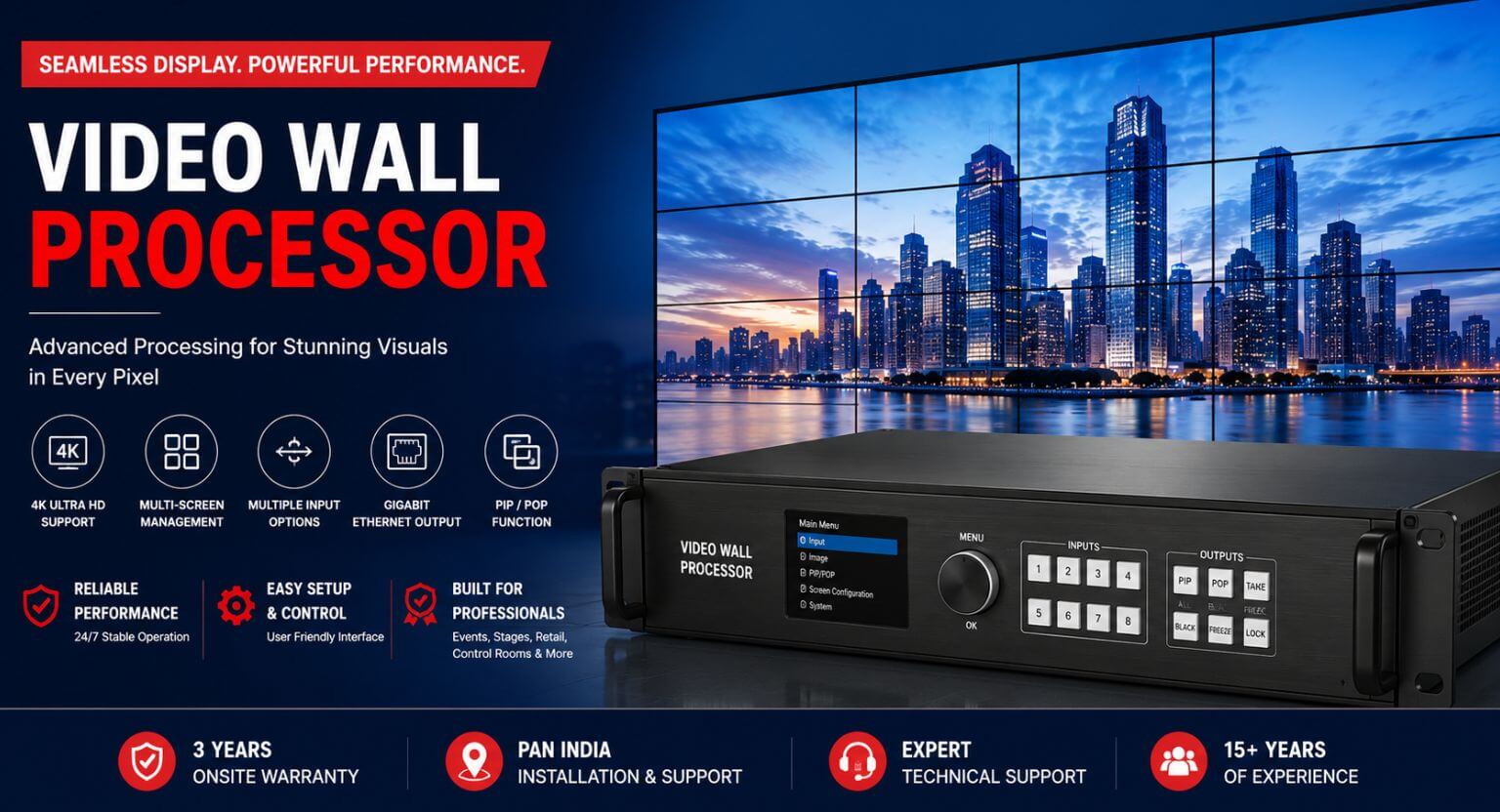
If you are planning an LED video wall for a stage, retail store, control room, or outdoor hoarding, the single most important hardware decision you will make is choosing the right video wall processor. This one device decides how sharp, smooth, and reliable your visuals will look no matter how good your LED panels are.
At Romio Technologies, we have spent 15+ years in the outdoor LED display industry, supplying and supporting video wall processors and LED display solutions across India including genuine Huidu (HD Series) processors backed by a 3-year onsite warranty on every project. This page explains everything you need to know before you buy in simple language, without the technical jargon.
What Is a Video Wall Processor?
A video wall processor is the hardware “brain” that sits between your video source (a laptop, media player, camera, or broadcast feed) and your LED display. It takes the incoming signal, resizes it to match your screen’s exact pixel layout, splits it across the panel grid if needed, and sends it out in a format the LED panels can display without lag, tearing, or colour mismatch.
Without a proper led video wall processor, even the most expensive LED panels will show a blurry, misaligned, or laggy picture. With the right processor, a video wall looks like one seamless, cinema-quality screen even if it is built from hundreds of individual panels.
How Does a Video Wall Processor Work?
- Signal Input – The processor receives video through HDMI, DVI, DisplayPort, VGA, or USB from a computer, camera, or media source.
- Scaling & Mapping – It automatically resizes and maps the picture to fit the exact resolution of your LED wall, whatever its shape or size.
- Signal Distribution – The processed signal is sent out through Gigabit Ethernet ports to the receiving cards inside the LED cabinets.
- Synchronisation – On large walls with multiple processors or cabinets, the units keep every panel in perfect sync so there is no visible seam or delay.
This entire process happens in real time, which is why a good led wall processor is critical for live events, news studios, and control rooms where even a one-second delay is unacceptable.
Types of Video Wall Processors
Broadly, video wall processors fall into two working categories. Understanding the difference will help you pick the right one for your project.
1. Live/Synchronous Processors (Real-Time Feed Processors)
These units display content live, straight from an external source such as a PC, camera, or broadcast desk, through physical ports like HDMI, DVI, DisplayPort, or VGA. They are the standard choice wherever content needs to change in real time control rooms, conference halls, or live events.
Common capabilities in this category include:
1. Entry-level 3-in-1 processors: that combine a scaler, sending card, and USB media player in one unit suited for budget event stages, small conference rooms, and fixed retail walls, typically handling around 1.3 to 2.6 million pixels through a handful of Gigabit output ports.
2. Mid-range dual-input processors: built for multi-source switching, offering features like split-screen (PiP/PoP) viewing and smooth fade transitions ideal for live broadcasts and multi-camera stage setups, supporting close to 4 million pixels with dual 4K-capable inputs.
3. High-end broadcast-grade processors: designed for stadiums and TV studios, supporting multiple 4K sources at once, ultra-low latency, and 5+ million pixel capacity across multiple Gigabit outputs.
4. Enterprise scaling units: for command centres and large corporate lobbies, capable of driving 7–10 million pixels through 12–16 Gigabit outputs, with support for layered windows and rack-mounted installation.
5. Conference-grade processors: built specifically for hybrid meeting rooms and large lecture halls, offering multiple presentation windows and synchronised audio, scaling up to 25+ million pixels through 20–40 network outputs.
6. KVM-integrated processors: used in security and traffic-control rooms, which allow an operator to control a host computer directly from the display wall itself.
7. Pure sending cards: which carry no internal media player, simply relaying a graphics card’s output directly to the screen with zero added processing delay common in production houses that run a dedicated media server.
8. Modular splicing processors: built with interchangeable input/output cards, used for very large or irregularly shaped video walls in smart-city and command-centre projects.
2. Offline / Standalone (Asynchronous) Controllers
These controllers don’t need a live feed at all. Content images, videos, or scrolling text is uploaded once via USB, Wi-Fi, or a cloud app, and the controller loops it automatically.
This category is common in:
1. Standalone media players: for digital posters and small storefront signage, running on Android with onboard storage and Wi-Fi.
2. Cloud-connected asynchronous cards: for street furniture, bus-stop, and highway displays, which can be scheduled and updated remotely over the internet or a 4G connection.
3. Entry-level async controllers: for small advertising boxes, managed through a simple mobile app.
4. Compact all-in-one boards: that combine both master control and receiving functions on a single circuit — useful where space inside the cabinet is very limited.
5. Strip and banner controllers: purpose-built for narrow scrolling displays like taxi-top screens, storefront lintels, and moving-text tickers.
6. High-capacity standalone boxes: used for large outdoor billboard networks, offering dual Gigabit outputs and cloud/4G management for content updates across many locations at once.
Huidu Video Wall Processors We Supply
Romio Technologies supplies genuine Huidu (HD Series) video wall processors one of the most trusted names in LED control hardware worldwide. Below is a quick reference to the Huidu models we deal in, grouped by the same live/offline categories explained above, so you can match a model to your project’s exact needs.
Live/Synchronous Huidu Processors
| Model | Recommended Applications | Maximum Pixel Capacity | Input / Output Ports & Key Features |
|---|---|---|---|
| HD-VP210 / VP210A | Budget Event Stages, Conference Rooms, Retail LED Displays | Up to 1.3 Million Pixels | Inputs: HDMI, DVI, VGA, CVBS, USB Outputs: 2 × Gigabit Ethernet Features: Built-in Video Scaler, Sending Card & USB Media Player |
| HD-VP410H / VP410S | Banquet Halls, Auditoriums, Live Events | Up to 2.6 Million Pixels | Inputs: HDMI, DVI, VGA, USB Outputs: 4 × Gigabit Ethernet Features: 1080P USB Playback, Audio Sync, Point-to-Point Scaling |
| HD-VP620 / VP630 | Multi-Camera Productions, Live Broadcasts, Stage Events | Up to 3.9 Million Pixels | Inputs: Dual 4K Video Sources Outputs: Multi-Gigabit Ethernet Features: Picture-in-Picture (PiP), Picture-by-Picture (PoP), Seamless Source Switching |
| HD-VP820 / VP830 | Stadiums, TV Studios, Large Outdoor LED Displays | Up to 5.2 Million Pixels | Inputs: Multi-Channel 4K Video Outputs: Up to 8 × Gigabit Ethernet Features: Ultra-Low Latency, Deep Colour Processing, Intelligent Image Scaling |
| HD-VP1220C / VP1620C | Command & Control Centres, Corporate Lobbies, Large Billboards | Up to 10.4 Million Pixels | Outputs: Up to 16 × Gigabit Ethernet Features: Dual 4K Pixel Mapping, Multi-Layer Window Support, Rack-Mount Design |
| HD-VP2060 / VP4060 | Conference Halls, Hotels, Lecture Theatres | Up to 26 Million Pixels | Outputs: 20–40 × Gigabit Ethernet Features: Multi-Window Layouts, Zero-Lag Audio Synchronisation, High-Capacity Processing |
| HD-KV210 / HD-KV410 | Security Monitoring, Traffic Control Rooms, Control Centres | Up to 2.6 Million Pixels | Inputs: HDMI, DVI Features: Built-in KVM Function for Remote Keyboard, Video & Mouse Control |
| HD-T16 / HD-T901 | Media Server-Based LED Display Systems | Multi-Million Pixel Expansion | Inputs: HDMI, DVI, DP Features: Dedicated Sending Card, Zero-Latency Signal Transmission, Cascade Ethernet Support |
| HD-A8 | Large Commercial Video Walls, Outdoor Advertising | Up to 10.4 Million Pixels | Inputs: HDMI 2.0, DP 1.4 Outputs: 16 × Gigabit Ethernet Features: Native 4K Hardware Decoding, Multi-Screen Frame Synchronisation |
| HD-A6L / HD-A5L / HD-A4L | Smart Cities, Digital Menu Boards, Retail Signage | 655K – 2.3 Million Pixels | Inputs: HDMI Outputs: Gigabit Ethernet Features: Android OS, Built-in Wi-Fi, Internal Storage, Live & Offline Playback |
Offline / Standalone Huidu Controllers
| Model | Recommended Applications | Maximum Pixel Capacity | Key Features & Highlights |
|---|---|---|---|
| HD-A3L | Digital Posters, Retail Menu Boards, Storefront Displays | Up to 655,360 Pixels | Android 11 OS, Built-in Wi-Fi, Dual USB Ports, Internal Storage, Standalone Content Playback |
| HD-C36C | Smart Street Lamp Displays, Outdoor Community Boards, Highway Advertising | Up to 520,000 Pixels | XiaoHui Cloud Support, Optional 4G Module, USB & LAN Connectivity, Low Power Consumption |
| HD-C16C | Small Advertising Displays, Shop Window Signage, LED Tickers | Up to 120,000 Pixels | Wi-Fi Control via Mobile App, 1080P Video Playback, USB Port, Compact Design |
| HD-C08L | Ultra-Slim Advertising Boxes, Compact LED Displays | Up to 2,048 × 1,024 Pixels | Integrated Controller & Receiving Card, Built-in Wi-Fi, LAN Support, Smooth 60Hz Playback |
| HD-D16 | Storefront LED Signs, Taxi Top Displays, Bus Route Information Boards | Up to 655,360 Pixels | Hardware Video Decoding, USB & LAN Support, Optional 4G Module, Reliable Continuous Playback |
| HD-D15 / HD-D35 | Scrolling Text Displays, Indoor Information Boards, Retail Tickers | Up to 131,072 Dots | Optimized for Scrolling Text, GIF & MP4 Playback, Wi-Fi Connectivity, Easy Content Management |
| HD-B6 | Outdoor Billboards, Advertising Networks, Digital Pillars | Up to 2.3 Million Pixels | Quad-Core Processor, Dual Gigabit LAN Ports, Dual-Band Wi-Fi, Cloud & 4G Content Management, Audio Synchronization |
Need help choosing between these? Share your screen size, resolution, and use case with our team, and we’ll recommend the right Huidu model along with full installation and a 3-year onsite warranty.
Key Features to Look For in a Video Wall Processor
When comparing options, buyers should evaluate:
* Pixel capacity – how many total pixels the unit can drive; this must match or exceed your screen’s total resolution.
* Input types – HDMI, DVI, DP, VGA, USB — make sure it supports your existing source devices.
* 4K/60Hz support – essential for sharp, flicker-free playback of modern high-resolution content.
* Number of Ethernet outputs – more outputs mean the ability to drive a larger wall directly.
* Latency – critical for live broadcasts, control rooms, and interactive displays.
* Redundancy and backup support – important for 24×7 installations like airports and command centres.
* After-sales support and warranty – often overlooked, but the single biggest factor in long-term reliability.
Applications of Video Wall Processors
– Retail storefronts and shopping mall displays
– Corporate lobbies and reception walls
– Conference rooms and hybrid meeting spaces
– Live events, concerts, and stage backdrops
– Traffic and security control rooms
– Outdoor billboards and highway advertising
– Television broadcast studios
– Smart-city public information screens
Why Choose Romio Technologies for Your Video Wall Processor?
15+ Years of Industry Experience – We have designed, supplied, and supported LED display projects across every major sector in India.
Pan-India Presence – From metro cities to smaller towns, we deliver and install outdoor LED display solutions nationwide.
3-Year Onsite Warranty – Every video wall processor and LED solution we supply is backed by a genuine 3-year onsite warranty, so you’re never left without support.
End-to-End Solutions – From site survey and processor selection to installation and after-sales service, we handle the entire project.
Outdoor Expertise – Our core specialisation is outdoor LED display systems, built to perform reliably in India’s diverse weather conditions.